



Key Trends in the Economy of City of Laktaši
Economic developments in the City of Laktaši during 2024 were characterized by a decline in overall economic activity (measured by total revenue), growth in foreign trade turnover, exports, and export-to-import coverage, as well as a decrease in the net profit of the local economy. Overall profitability indicators remained around the average level recorded in the economy of Republika Srpska. Employment continued to grow, accompanied by a reduction in the unemployment rate.
The local economy remains exposed to indebtedness, with the debt-to-equity ratio exceeding the Republika Srpska average, although the creditworthiness of businesses in Laktaši is comparatively stronger. Liquidity remains insufficient, particularly in terms of quick and cash liquidity ratios. While the current ratio exceeds both one and the Republika Srpska average, the quick and cash liquidity ratios remain below one, although still above the Republika Srpska average. Businesses continue to face challenges in securing favourable financing sources, marketing their products, and, in particular, collecting receivables, as reflected in an average collection period that exceeds the Republika Srpska average. At the same time, the establishment of new companies continued, alongside the liquidation and bankruptcy of a number of existing business entities.
The high level of economic development of Laktaši, reflected in its long-standing status as a developed municipality and an employment rate above the Republika Srpska average, enabled it to attain city status, thereby further strengthening its position as an attractive destination for both investors and new residents. Migration trends remained positive in 2024, with a net migration balance of 162.
In terms of foreign trade turnover, the City of Laktaši ranks second in Republika Srpska, behind the City of Banja Luka. It ranks third in imports and fourth in exports. By the number of companies, total revenues, and net profit generated, Laktaši ranks third in Republika Srpska, behind Banja Luka and Bijeljina. In terms of the number of entrepreneurs, it ranks sixth, following Banja Luka, Bijeljina, Prijedor, Gradiška, and Doboj. Regarding employment in companies, Laktaši again ranks third, behind Banja Luka and Bijeljina, while it ranks fifth in total employment, behind Banja Luka, Bijeljina, Prijedor, and Doboj.
In addition to its favourable geostrategic location and established reputation as an entrepreneurial centre, one of Laktaši’s key advantages is the City’s continuous investment of substantial budgetary resources into capital projects aimed at improving living conditions and supporting economic development. Alongside investments in traditional infrastructure, particular emphasis has been placed on business infrastructure, especially the Aleksandrovac I and Aleksandrovac II Industrial Zones. Investors also benefit from a range of incentives, including efficient administrative procedures for obtaining permits and other documentation, the Business Friendly Certification (BFC) for a favourable business environment, reduced administrative fees, financial incentives in the form of lower municipal charges for the construction of manufacturing and agricultural facilities, and the possibility of paying obligations in instalments.
The creation of a favourable investment climate has resulted in a significant inflow of capital. Companies registered in Laktaši include capital originating from approximately 30 countries worldwide, representing more than 30% of all investor countries registered in Bosnia and Herzegovina. Laktaši’s attractiveness as a business destination is further confirmed by the presence of major international and regional companies, including Coca-Cola, PepsiCo Investments, OAO NeftaGazInkor, Perutnina Ptuj, Mahle Group, Kolektor CCL, Cablex Group, Agrokor, Sano, and others.
A substantial volume of investment projects is currently being implemented in the City of Laktaši, contributing significantly to overall investment activity and employment generation within Republika Srpska.
Chart 1. Number of companies by sector and activity
Business entities – Laktaši Number of business entities per thousand inhabitants

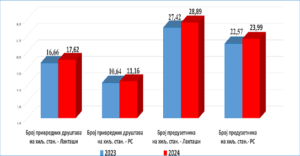
The structure of business companies (614 in total) by size indicates the predominance of small enterprises (including micro and small enterprises), both in Republika Srpska and in the City of Laktaši. Over the course of the year, the size structure of companies operating in the city remained largely unchanged:
- Small enterprises – 589
- Medium-sized enterprises – 21
- Large enterprises – 4
The number of small enterprises increased by 35, the number of medium-sized enterprises increased by 2, while the number of large enterprises decreased by 2.
Financial Performance of the Economy
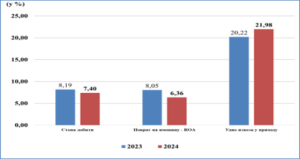
The overall level of economic activity in the City of Laktaši (measured by total revenue) remains highly developed. The economy, viewed as a whole, continues to operate profitably; however, profitability levels remain insufficient, and export orientation is still below the desired level.
Chart 2. Total revenue, profit and export (in millions of BAM) and Profit rate, ROA, share of export in revenue (in %)
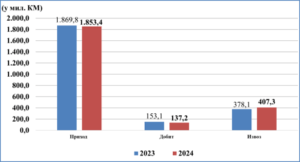
Total revenues of the local economy (generated by companies, cooperatives, and other legal entities operating on a for-profit basis that submitted annual financial statements for 2024) decreased by approximately BAM 16.5 million (BAM 16,425,936), or 0.88%, compared to 2023, when total revenues amounted to BAM 1,869,809,999.
As a result, total revenues in 2024 amounted to approximately BAM 1.85 billion (BAM 1,853,384,063), reflecting an exceptionally high level of economic activity.
The economy of Laktaši accounted for approximately 5.5% (5.66%) of the total revenues generated in Republika Srpska.